Source-backed guide · Updated 2026-07-21
Pathogenic Burn Build Guide: How Burn Works, What to Stack, and Why Combos Fail
How Burn works in Pathogenic: the Organelles that apply it, how burn scales with rarity, what to keep or reroll, and why two builds deal different damage.
Published by Pathogenic Game Wiki Editorial Team · Updated 2026-07-21
Quick answer
Burn in Pathogenic is a damage-over-time status. Two Organelles apply it directly: Pyroflagellum leaves a burning trail when you dodge, and Oxidator applies burn-on-hit — doubled at Epic+ rarity. Players also reach large burn totals with high-frequency projectile builds and melee builds, and a fire option called Pyrogenesis can spread burn when a burning enemy dies. Burn grows fastest when it is applied often and the build is correctly chained to Overcharge, so a burn build is a chain, not a pile. The “5000 burn” figure is one player’s result, not a target the game sets; the “Reach X Burn” unlocks are real and depend on the right parts showing up.
Key facts
- Burn sources
- Pyroflagellum (burn trail on dodge) and Oxidator (burn-on-hit, 2× at Epic+)
- Biggest burn scaler
- Oxidator burn doubles at Epic+ rarity
- Other ways to burn
- Fast projectile builds, melee (Actin Whip + Pyrosome), and Pyrogenesis (spreads burn)
- Is “5000 burn” a target?
- No — it is one player’s result, not a goal the game sets
- Is “Reach X Burn” real?
- Yes — a Burn-threshold unlock that depends on getting the right parts
- Is Toxisome burn?
- No — it applies toxin, a different damage-over-time type
- How to check your damage
- Open the expanded tooltip and read Last Room Damage per Organelle
- Current as of
- Pathogenic 1.0 (v1.0.11), July 2026
Burn delivery methods in Pathogenic
Pyroflagellum and Oxidator are built into the game. The other three are popular community builds. All of them apply burn — they differ in how, and how fast.
| Route | How it delivers burn | Watch out |
|---|---|---|
| Trail on dodge | Burning trail behind you when you dodge | No trail while standing still — keep moving to lay it |
| On-hit | Burn-on-hit, doubled at Epic+ | Below Epic+ burns at baseline strength |
| High-frequency hits | Many fast hits, each able to apply burn | Needs a working chain to the burn source |
| Melee contact | Contact hits apply burn (e.g. Actin Whip + Pyrosome) | Must actually reach and hit the target |
| Spread on death | Moves burn to a nearby enemy when a burning enemy dies | Read its tooltip before counting on the spread |
Before you start
- Treat the live in-game tooltip as the final authority after any balance patch.
- Use Pyroflagellum (burn trail on dodge) and Oxidator (burn-on-hit) as your core burn sources.
- Push Oxidator to Epic+ before adding more parts — its burn doubles there.
- Burn grows with application rate: favor fast, well-connected delivery over collecting fire-themed parts.
- Wire a Mitochondrion to each burn part with a visible chain arrow, and meet each trigger.
- Confirm output with Last Room Damage in the expanded tooltip, not floating combat numbers.
What Burn is in Pathogenic
Burn is a damage-over-time status, not a single hit. Once an enemy is burning, it keeps taking damage over a short window instead of only on impact, so the same hit keeps paying out while you focus another target. The official store page lists “burn” alongside slash and shoot as a core way to deal damage, so it is a first-class damage type — not a niche effect.
Two Organelles apply Burn directly: Pyroflagellum, which leaves a burning trail when you dodge, and Oxidator, which applies burn-on-hit. Players also reach large burn totals with other delivery methods, including high-frequency projectile builds and melee builds. The mechanic is real and well-used, and there is more than one way to deliver it.
The Organelles that apply Burn
Pyroflagellum is a flagellum — a movement-and-attack part. Its burn is tied to dodging, so it rewards an active playstyle: the more you dodge through enemy groups, the more trail you lay. Its damage value has been balance-tuned between updates (the demo moved it from 5 to 7), so trust the live tooltip for the current number, not any older screenshot.
Oxidator applies burn-on-hit, and the decisive detail is rarity: at Epic or higher, its burn is doubled. That makes Oxidator the part where rarity matters most for a burn build — a Common Oxidator technically burns, but at half the strength of an Epic one.
When a fire-themed pick is neither of these, read the tooltip before assuming it is burn. Players also use a fire-themed pick named Pyrosome (commonly paired with Actin Whip for a melee burn route) and a fire option called Pyrogenesis that spreads burn — both are covered below, so check their tooltips in your run before you rely on them.
Other ways players deliver burn
Players have shared several ways to deliver burn, and they tend to share the same logic: burn grows fastest when it is applied often, to the right target, with the build actually connected. These are community approaches, not fixed recipes — take what your run offers.
High-frequency projectile builds connect several fast-firing weapons so each hit can apply burn. One player describes five lasers linked to an Attractor with a burn-support organelle, reaching thousands of burn within seconds and completing the game. Melee builds apply burn on contact; a commonly recommended pairing is Actin Whip with Pyrosome. A fire option called Pyrogenesis can move burn to a nearby enemy when a burning enemy dies, turning single-target burn into area pressure — read its tooltip to confirm the spread before you rely on it.
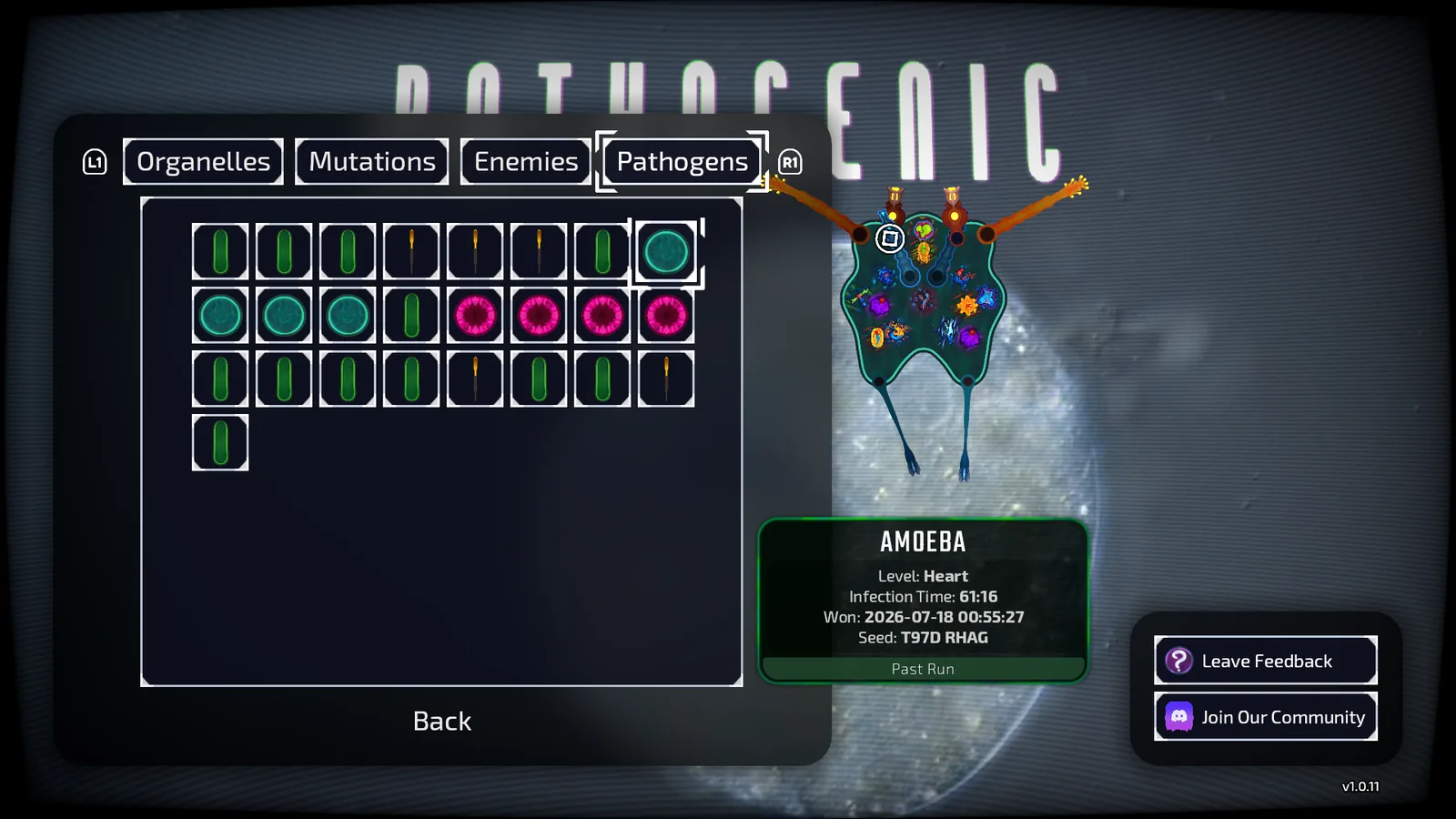
A release-version Amoeba build its player calls a burn build is recorded clearing Heart on v1.0.11 — which shows a burn build can finish a run, not that this exact setup is the only one that works.
How Burn scales: rarity, application rate, Overcharge
Burn output scales in three ways, and rarity is the biggest lever. Oxidator doubles its burn at Epic+, so raising one Oxidator to Epic+ beats adding a second disconnected burn part. The rarity ladder runs up through Epic, Legendary, and Mythic (two Legendary of the same type combine into a Mythic), so rarity upgrades are a reliable path to more burn.
Application rate is the second lever and the main reason player builds reach large totals: burn applied many times per second grows far faster than burn applied once. The high-frequency projectile and melee routes above are built on this. The game doesn’t spell out the exact tick rate or stacking math, so trust your tooltip and Last Room Damage over any formula you read online.
Overcharge is the third lever. A Mitochondrion pushes Overcharge through valid chain arrows into your burn Organelles, and Overcharge stacks so effects can charge faster. Overcharge won’t multiply every burn source on its own — it powers the connected effect, so check each part separately.
Build a burn line: keep, reroll, connect
Think of the build as a line, not a pile. You want one Overcharge source, one or more burn-applying parts, and valid arrows between them. A screen full of fire-looking parts with no connections will not burn anything.
Keep Pyroflagellum, Oxidator, or another burn route that is actually offered, a Mitochondrion to power it, and any Overcharge Strength or range upgrade that extends the burn. Reroll parts that deal a different damage type, and reroll duplicate burn parts that cannot all receive a valid connection.
- Keep Pyroflagellum with a dodge-heavy playstyle, and Oxidator pushed toward Epic+.
- Keep a Mitochondrion and a connection path to every burn part.
- Keep range or area upgrades — they extend the trail or hit zone so more enemies burn.
- Reroll parts whose tooltip says toxin, shock, or splash rather than burn.
- Reroll a second Mitochondrion if it cannot reach a burn part the first one does not already cover.
Adapt when RNG is poor
You will not always be offered the burn source you wanted. The fix is to protect the chain and switch delivery methods rather than abandoning burn entirely. If Oxidator does not appear, Pyroflagellum plus movement can carry a burn line; if neither appears, a high-frequency weapon plus a burn-support part can still build a working route.
Use range and area to compensate for fewer burn parts. A wider Pyroflagellum trail or a longer-reach hit spreads the same burn across more enemies, which often matters more than a second burn source. Range and Overcharge Strength upgrades combine additively, so each one still helps.
Some in-game unlocks ask you to reach a Burn threshold — players call these “Reach X Burn” requirements, and they depend on the right burn parts showing up. Plan for several attempts rather than one lucky run, and prioritize a delivery method that applies burn very fast.
Why two burn builds deal different damage
Two builds can both look like burn builds and still produce very different damage. The difference is usually in the chain, the application rate, the target, or the rarity — the things the editor and tooltips show you, not the parts list.
A burn part with no chain arrow receives no Overcharge and underperforms. A connected source whose trigger never fires produces nothing. A low-frequency build applies burn too slowly to stack. An Oxidator below Epic+ burns at half strength. A build that mixed in Toxisome is partly dealing toxin, which does not count as burn. And a build tuned to stack burn on one boss will look very different from one tuned to clear rooms — comparing the two directly is misleading.
What the “5000 burn” number actually means
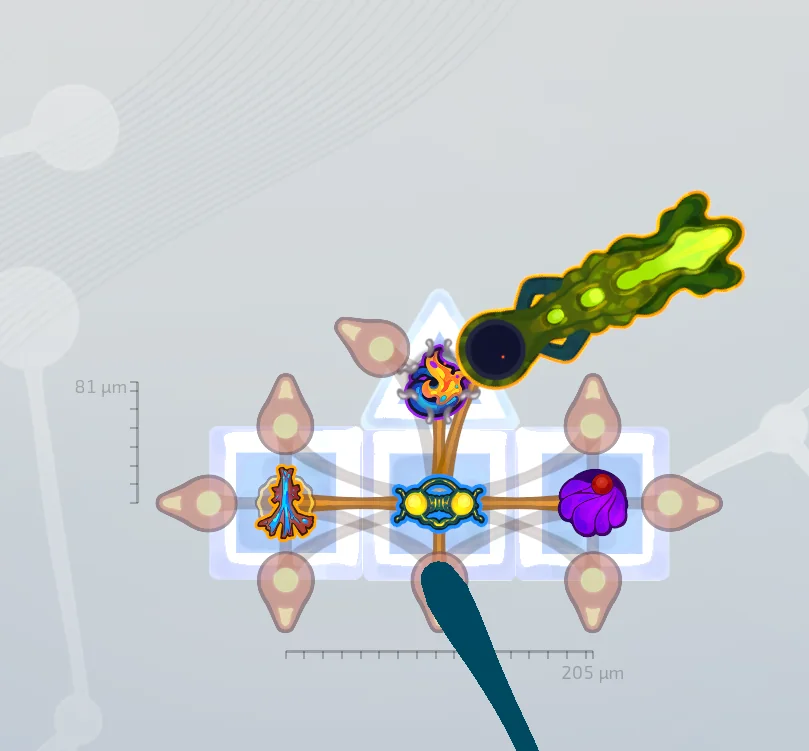
“5000 burn” circulates because a player (MoObius) said they reached 5000 burn on an enemy in under a second. That’s one player’s result — not a target, achievement, or breakpoint the game sets. The screenshot shared with that statement shows the build layout only: no enemy, no burn stat, and no 5000 value.
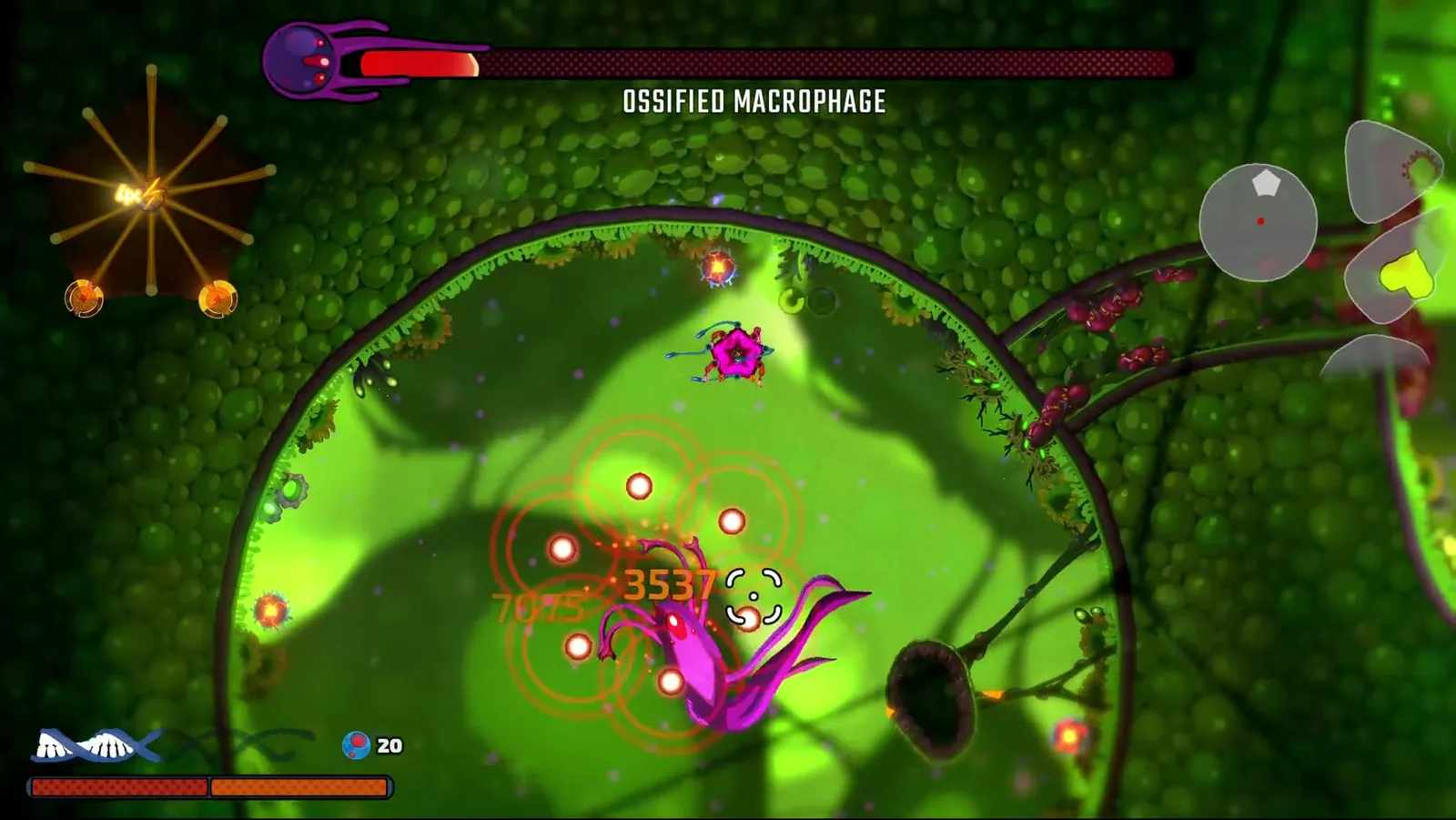
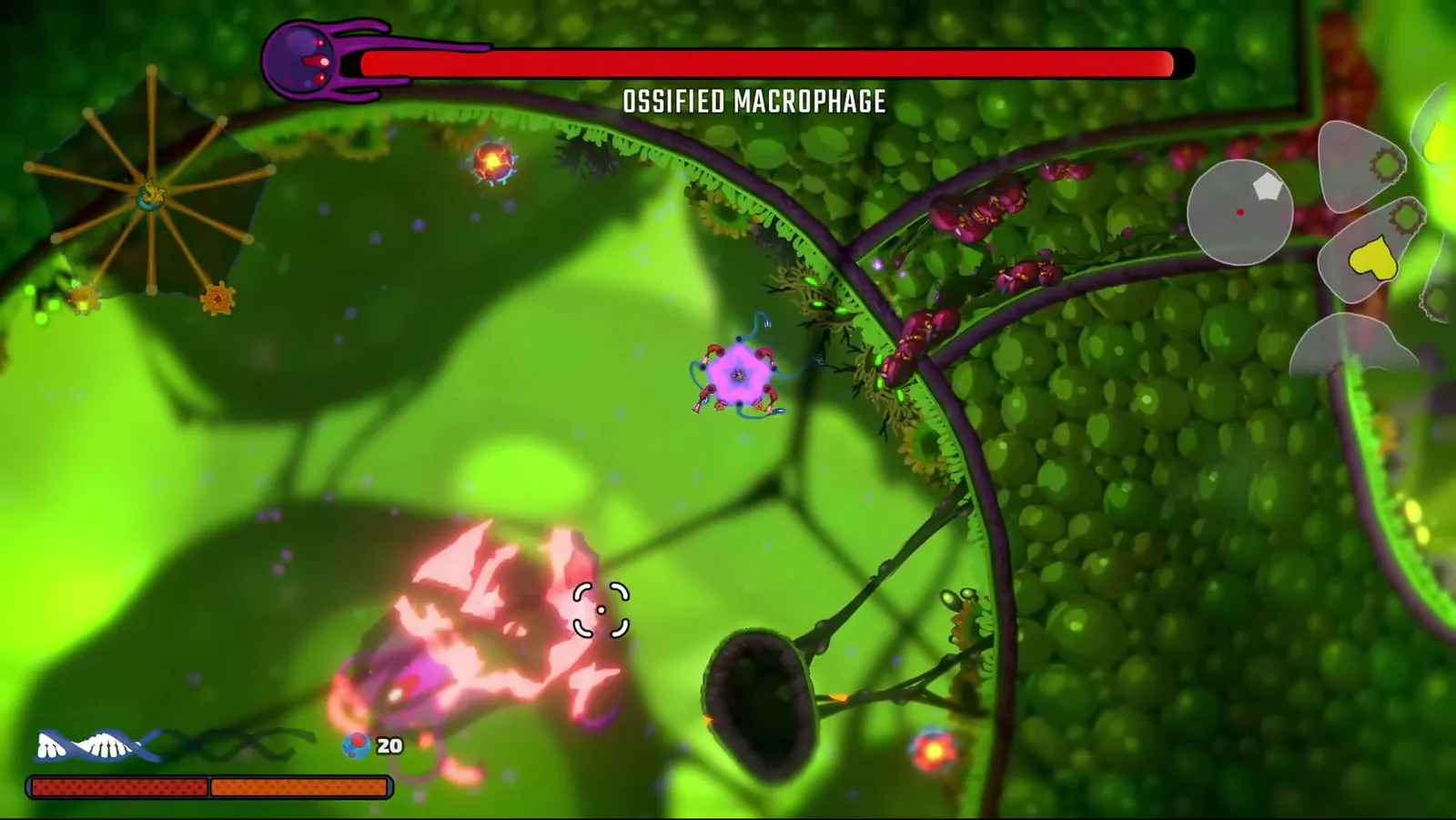
A separate Medal clip by another player (Fracix) shows a burn-labeled fight against the Ossified Macrophage with repeated orange numbers and a visible 3537. The clip shows burn piling up fast in a real fight, though you can’t tell from it whether the 3537 is a single burn tick, and it isn’t the same build as MoObius’s layout.
Both show how fast burn can climb with frequent hits, good chaining, and high rarity — not a number any build will reach.
Pyrogenesis and “Reach X Burn”, explained
Pyrogenesis is a fire option the game suggests for fire Organelles. One player describes it as moving burn to a nearby enemy when a burning enemy dies — a spread effect that can turn single-target burn into area pressure. Check its tooltip in your run before counting on the spread. It’s a strong option, not something every burn build needs.
“Reach X Burn” is what players call in-game unlocks that ask you to reach a Burn threshold. They are real, and they depend on getting the right burn parts and a fast delivery method, so they can take several runs. The exact number and reward aren’t listed here — when one appears, read the card to see its threshold and reward.
Diagnose and verify with Last Room Damage
Pathogenic records the damage each Organelle dealt in the previous room, visible in the expanded tooltip. That single number tells you whether a burn part is actually contributing, which floating combat text cannot. Use it after every change so you stop guessing.
- 1.Record the game version, the burn part, its rarity, and the chain direction.
- 2.Open the expanded tooltip and read Last Room Damage after a normal combat room.
- 3.If the value is zero or near-zero, check the chain arrow first, then the trigger.
- 4.Confirm the tooltip says burn, not toxin.
- 5.Change one variable — connection, trigger, rarity, or delivery method — and compare in a similar room.
What is confirmed and what may change
Burn and its core parts — Pyroflagellum, Oxidator, the Epic+ rarity doubling, chaining, and Last Room Damage — are part of the current game. The community builds (fast projectile, Actin Whip + Pyrosome, Pyrogenesis’s spread, the 5000 figure, and Reach X Burn unlocks) come from player posts and can shift between patches, so check the tooltip in your current run before committing to any of them.
Frequently asked questions
What applies Burn in Pathogenic?
Two Organelles apply it directly: Pyroflagellum, which leaves a burning trail when you dodge, and Oxidator, which applies burn-on-hit (doubled at Epic+). Players also build burn through high-frequency projectile and melee routes. Toxisome applies toxin, a different damage-over-time type.
Does Burn stack in Pathogenic?
With a fast, well-connected build, burn can climb into the thousands within seconds. The game doesn’t publish the exact tick rate or stacking math, so think of fast stacking as something application rate drives — not a fixed multiplier.
Is “5000 burn” a real target?
No. One player reported hitting 5000 burn in under a second, and a clip shows a 3537 mid-fight. Those are player results that show how fast burn can climb — not a goal the game sets.
What is Pyrogenesis in Pathogenic?
A fire option the game suggests for fire Organelles. One player says it moves burn to a nearby enemy when a burning enemy dies. Check its tooltip in your run before counting on the spread.
What does “Reach X Burn” mean?
It’s what players call in-game unlocks that ask you to reach a Burn threshold. They’re real, and they depend on the right parts showing up, so they can take several runs. The exact number and reward aren’t listed here — read the card when it appears.
Why does my burn build deal no damage?
Check the chain arrow, the trigger, the application rate, the rarity (Oxidator doubles at Epic+), and whether the part is burn or toxin. Also avoid comparing a boss-stacking build with a room-clear build. Use Last Room Damage to see which part is the problem.
Does Overcharge multiply every Burn source?
No. Overcharge powers the connected effect and stacks, but it won’t multiply every burn part on its own. Check each burn part’s contribution separately with Last Room Damage.